Are Startup Directories Worth It in 2026? An Honest Answer
 Avinash9 min read
In short:Yes, startup directories are worth it for a new product with no audience, but only the right ones. They rarely send big traffic. They help search engines and AI tools find and trust a new site, and the best ones give a dofollow link. Pick a short list of relevant directories with indexed listing pages, and skip mass submissions.
A founder in r/SideProject asked a question I hear every week: which startup directories are actually worth submitting to right now? Their list is honest. They want to know which ones still send real traffic, which ones help discovery and indexing, and whether manual submissions beat automated tools.
I track 142 launch platforms at FasLaunch, so I can answer with data, not opinions. Here is the short version, then the proof.
Are startup directories worth it in 2026?
Yes, for a new product with no audience. But only if you treat them as three separate jobs, and only if you pick well.
- Discovery. A brand-new site has no links, so search engines find it slowly. A listing on a real directory gives crawlers a path to you.
- Trust signals. Your name, description and link appear on a site that other sites already cite. AI answer tools and search engines use these signals to work out who you are.
- Some referral traffic. A few directories send visits. Most send a trickle.
Directories do not replace a launch on Product Hunt, a strong post in a community, or good content. They sit under those things and make them work better. If someone promises that a directory blitz will bring thousands of users, walk away.
Do startup directories still send real traffic?
A few do, and most send very little. That is normal, and it is fine.
Product Hunt is the clear example. It sends a burst of visits on launch day and a long tail after. Communities like Indie Hackers send traffic when people comment on your post, not when you list a link. Small directories usually send a handful of visits a month.
So judge a directory on the three jobs above, not on visits alone. A listing that sends 12 visits a month and gets your homepage crawled in week one still earns its place.
You can measure this in ten minutes. Add a ?ref= tag to each listing link, open your analytics, and check the referral source after 30 days. Keep the directories that send visits or show up in your indexed pages. Drop the rest from your future launches.
Do startup directory backlinks help SEO?
Some do. The type of link and the quality of the page matter more than the size of the site.
A dofollow link tells search engines that the directory vouches for you. A nofollow link tells them not to pass that vote. Since 2020, Google treats nofollow as a hint, not a strict rule, so a nofollow link from a strong site can still help. It also brings human visitors, and visitors are the point.
Here is what the data shows. Across the 142 platforms in the FasLaunch database:
- 104 give a dofollow link (73%)
- 36 give a nofollow link (25%)
- 2 give a mixed link, depending on where it appears
Now a warning. Domain Rating (DR) belongs to the whole website, not your listing page. Facebook has a huge DR, but a business page there does not pass much to your site. So check three things before you submit: is your listing page indexed, is the link dofollow, and is the site relevant to your product?
I keep this simple in the database: DR, cost and link type sit side by side for every platform, so you can compare in seconds.
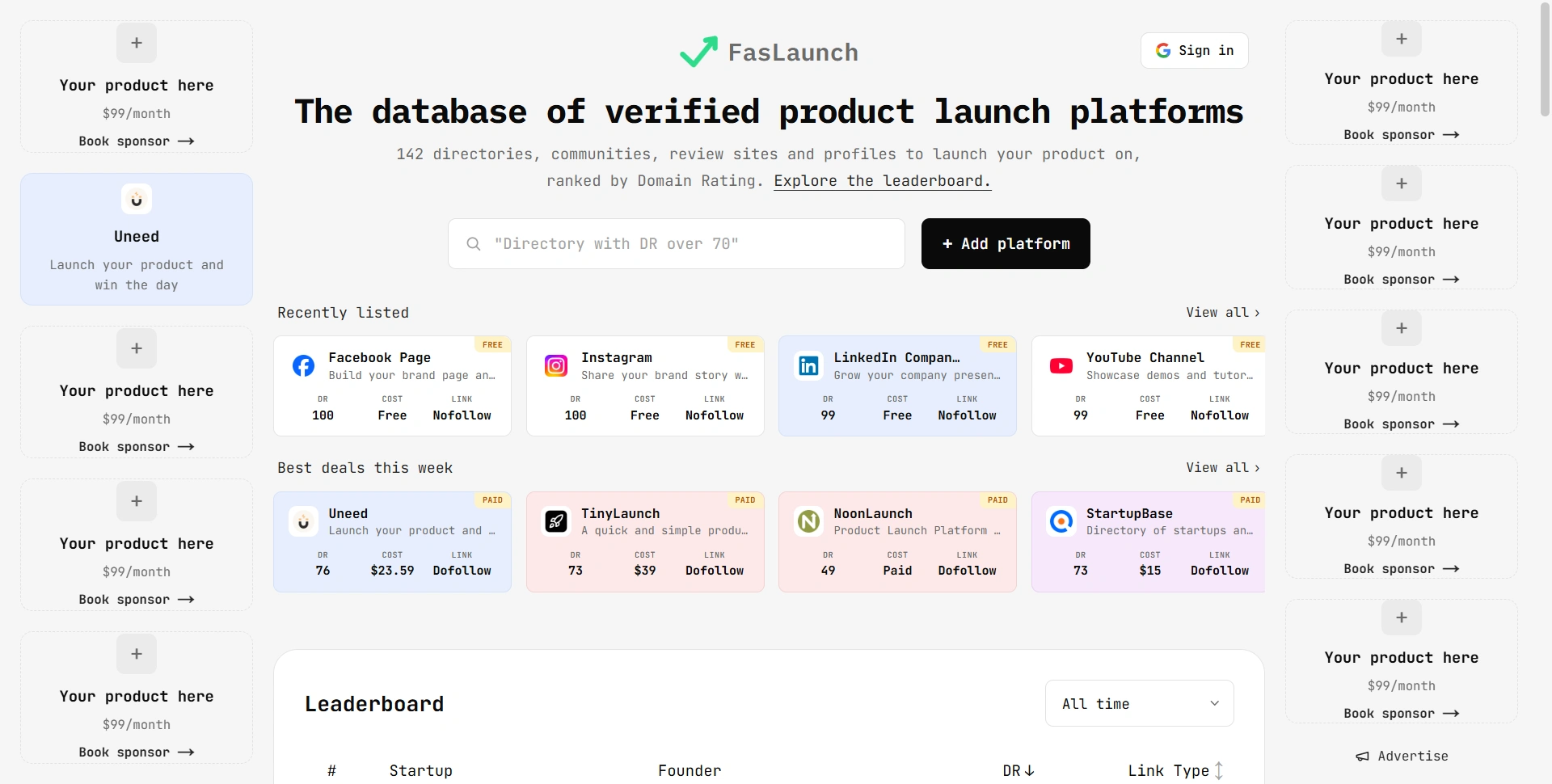
The FasLaunch platform database: every platform shows its Domain Rating, cost and link type next to each other.
Can directory submissions really increase your Domain Rating?
Yes. I have seen it twice, up close, so I am not guessing.
A client stuck at DR 9 for 1.5 years. His site sat at Domain Rating 9 for more than a year and a half. I asked him to make a few paid directory submissions, chosen with a clear strategy. In one month, his DR moved from 9 to 30.
My own product, NoonLaunch, starting at DR 0. I started submitting it to directories. In two months its DR passed 35, and in five months it crossed 45. That is solid progress for a product that began with no links at all.
For both sites, organic traffic and SERP rankings grew, and the brands showed up more often in AI answers. Those are the results that matter, not the DR number itself.
Keep one caution in mind. Domain Rating is Ahrefs' score, not a Google ranking factor. It shows that good links landed, and the rankings and citations are the outcome. Your results depend on the directories you pick and on your product. That is why the rest of this guide focuses on choosing well.
Which startup directories help with discovery and indexing?
The ones with real, indexed listing pages that link to you with a normal link.
Here is a small sample from our data, so you can see how different the trade-offs look:
| Platform | DR | Cost | Link |
|---|---|---|---|
| Product Hunt | 91 | Free | Nofollow |
| SaaSHub | 81 | Free | Nofollow |
| Peerlist | 77 | Free | Dofollow |
| BetaList | 77 | $99 | Dofollow |
| Uneed | 76 | $23.59 | Dofollow |
Look at what this table teaches. The highest-DR platform gives a nofollow link, but it brings a large audience. A free platform can give a dofollow link. A paid one is not always better. Price and value do not move together, so check each one.
These numbers also show why the whole set is strong. The median DR across all 142 platforms is 73.5. 86 of them have a DR of 70 or higher, and 32 are above 90. Only one sits below 30. If you want the full ranked list, open the launch platform leaderboard.
AI tools such as ChatGPT and Perplexity also lean on sources they trust, and directories are often among them. Read what GEO is and how to get cited in AI answers to see how that works.
Is manual submission better than automated directory submission services?
Manual wins, almost every time.
Automated services push the same text to hundreds of sites. Many of those sites are thin, unindexed, or stuffed with links. Google's spam guidance lists low-quality directory links as an example of link spam, so a mass blast can do more harm than good.
Manual submission gives you three advantages:
- You choose the category and write a fresh description for each site, so no two listings look copied.
- You submit only where your audience is, so the traffic that does come is relevant.
- You keep control. You know exactly where your link lives and can fix it later.
The cost is your time. That is why I suggest a short list first. If you want a framework for building it, read our guide on how to choose product launch platforms.
Which startup directories should you avoid?
Avoid any directory that fails one of these checks:
- Its listing pages are not indexed. Search
site:theirdomain.com "your category"in Google. If you see no listing pages, the link does little. - It looks abandoned. No new products this month, broken pages, old copyright dates.
- It sells "guaranteed" rankings or authority scores. Nobody can guarantee that.
- It asks for a reciprocal link to a page full of unrelated sites.
- It lists everything. Casinos, pills and startups in one place is a link farm.
- It charges a lot and shows no traffic or audience proof.
The r/SideProject thread says most "top startup directory" lists feel outdated or spammy. I agree. Check every name against the list above before you spend an hour on it.
What did we find in 142 launch platforms?
Here is the full picture from the FasLaunch database:
| What we measured | Result |
|---|---|
| Platforms tracked | 142 |
| Free to list | 85 (60%) |
| Paid | 27 |
| Cost still being verified | 30 |
| Dofollow link | 104 (73%) |
| Free and dofollow | 50 |
| Free, dofollow, and DR 50+ | 40 |
The last row matters most. 40 platforms are free, give a dofollow link, and have a strong DR. You can build a solid launch base without paying for anything. Cost is not the barrier. Time and fit are.
Remember the caveat: the set includes profiles and communities, not only classic directories, and DR is a domain-level number. Use it to rank options, then confirm the listing page and the audience by hand.
How many startup directories should you submit to?
Start with 10 to 15. Pick them by fit, not by fame:
- Two or three high-DR platforms with real audiences.
- Four or five dofollow platforms in your category.
- A few communities where founders discuss products.
Then watch the referral data for a month and expand. Depth beats volume, because every good listing needs a good description, a category, and a working link.
Where can I launch a startup and get a dofollow link for free?
This is the reason I built FasLaunch. I wanted a place where you add your product, go live in minutes, and get a real page that search engines and AI tools can read. There is no queue and no waiting for a launch day.
You have three ways to launch:
- Free with our badge. Add the FasLaunch badge to your homepage, verify it with one click, and launch for free with a dofollow link.
- Pay once. Skip the badge and pay a one-time fee, starting at $5, for a dofollow link and nothing to add to your site.
- Free with a nofollow link. Launch without a badge. Every account gets two of these.
Each product page answers five questions that visitors and AI tools ask: who it is for, what problem it solves, what job it does, how it solves it, and what makes it different. Founders must fill these in, so every page carries real substance. Here is a live example, DeepCleanMac:
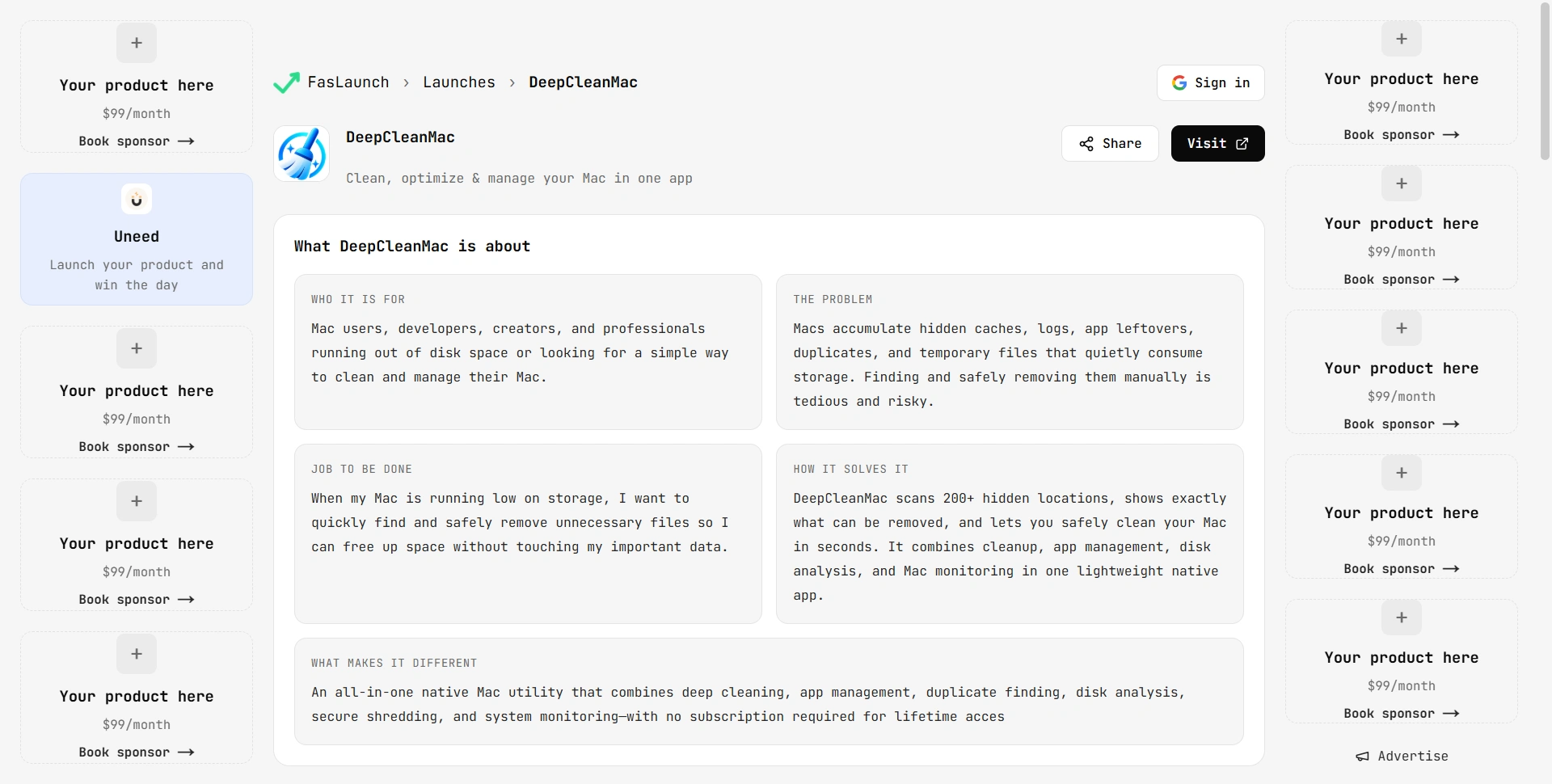
A FasLaunch product page. The five story boxes tell a visitor who the product is for and why it matters.
Below the story, each page shows the product's Domain Rating, pricing, category, maker and launch date, so visitors and search engines see the facts in one place.
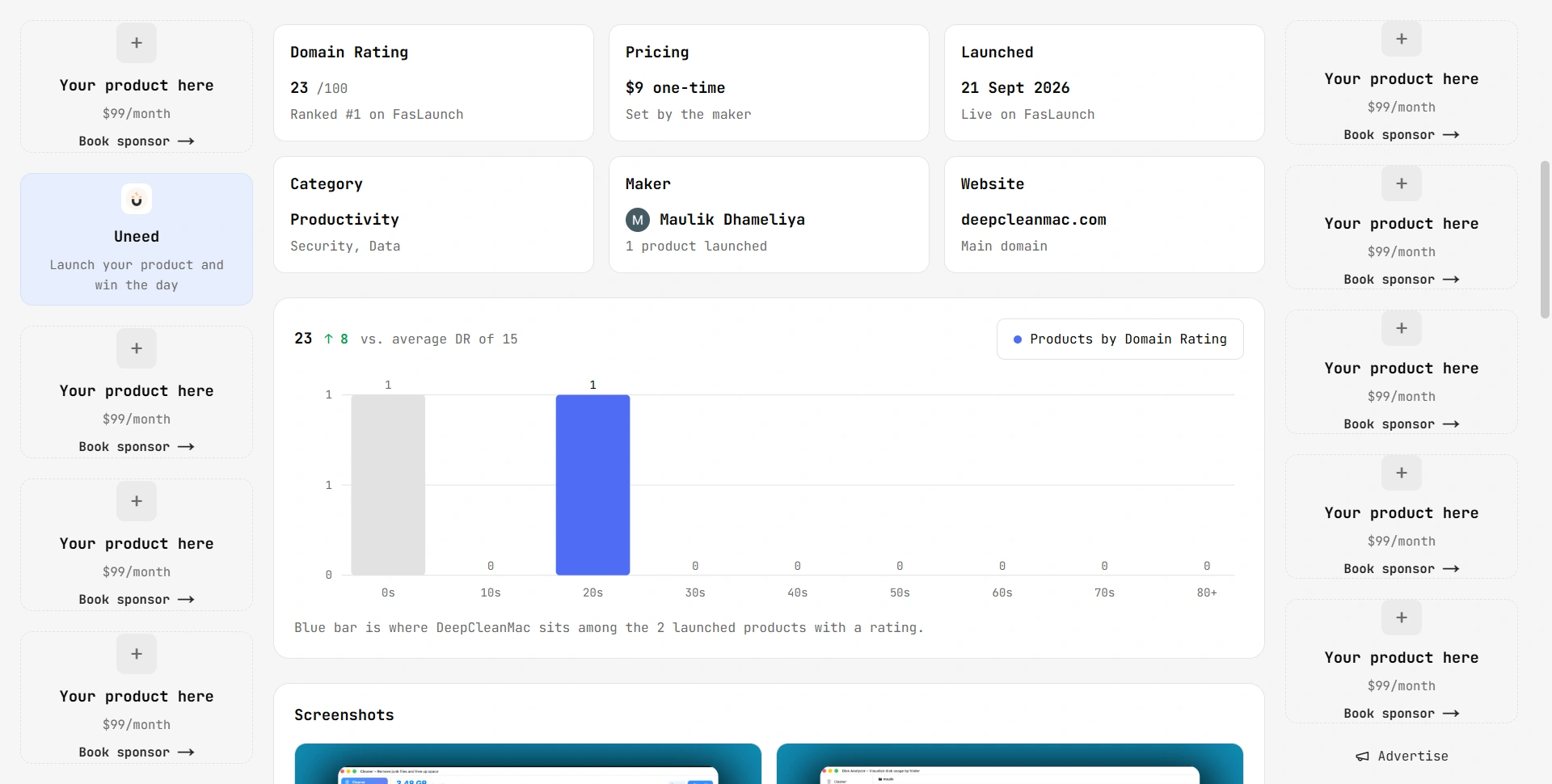
The facts panel: Domain Rating, pricing, launch date, category and maker.
Launched products also appear on the FasLaunch leaderboard, ranked by Domain Rating, and each maker gets a builder page. You can see live examples like DeepCleanMac and VegaReview.
Your next step
Start small and start today. Take one hour and do this:
- Open the platform database and filter for free, dofollow platforms that fit your audience.
- Pick your first 10.
- Write one clear description, then adjust it for each site.
- Tag each link so you can measure the results.
- Launch your product on FasLaunch and get a live page in minutes.
Directories will not build your business alone. They give a young product a base that search engines, AI tools and people can find. Do it right, and that base keeps working for you long after launch day.
Which directory has worked best for you so far? Tell me on X and I'll add what the community learns to our database.
Frequently asked questions
Are startup directories still worth it for a new SaaS?
+
Yes, if you choose a small set of relevant directories with real listing pages. They help a new site get discovered, indexed and cited. They rarely send large traffic on their own, so treat them as a base, not a launch spike.
Do startup directory backlinks help SEO?
+
Some do. A dofollow link from a relevant, indexed page passes a useful signal. A nofollow link still helps people find you, and Google treats it as a hint. Links from spammy or unindexed directories add little and can hurt.
How many startup directories should I submit my product to?
+
Start with 10 to 15 that fit your audience and have indexed listing pages. Add more only after you see which ones send visits or get your pages crawled. Fifty low-quality submissions never beat ten good ones.
Are automated directory submission services worth paying for?
+
Usually not. They post the same text to hundreds of sites, and many of those sites are thin or unindexed. Google lists low-quality directory links as an example of link spam. Submit by hand to a short list instead.