


Zinn Hub Review 2026: Best Alternative to Upwork
 Avinash8 min read
Zinn Hub is a strong Upwork alternative for freelancers who want free project proposals and founders buying clearly scoped services. It combines fixed-price Zinns, custom projects and freelancer profiles. Its first $500 in sales is commission-free on the Free tier, but later commissions, optional memberships and payment costs deserve a closer look before switching.
Paying to apply for work feels different when you are still trying to win your first client. You spend time writing the proposal, then spend money sending it, without knowing whether anyone will reply.
That is the problem that caught my attention while researching this Zinn Hub review. The platform combines service listings with project proposals, and its entry plan lets freelancers pitch without buying proposal credits.
For founders, the appeal is different: find someone to finish a specific job without turning every small task into a recruitment exercise.
I reviewed Zinn Hub's public marketplace, freelancer information, pricing and supplied screenshots. I haven't completed a paid order there, so this review evaluates its offering and published terms, rather than claiming a delivery experience I haven't had.
What is Zinn Hub?
Zinn Hub is a freelance marketplace where buyers can purchase packaged services, post custom projects or explore freelancer profiles. Its packaged services are called Zinns, and its freelancers are called Zinners.
The homepage makes those routes easy to understand. You can browse an existing offer or describe the work you need and invite proposals. The platform also advertises 46 site languages and 59 display currencies. Those are platform claims; I haven't tested every language or currency.
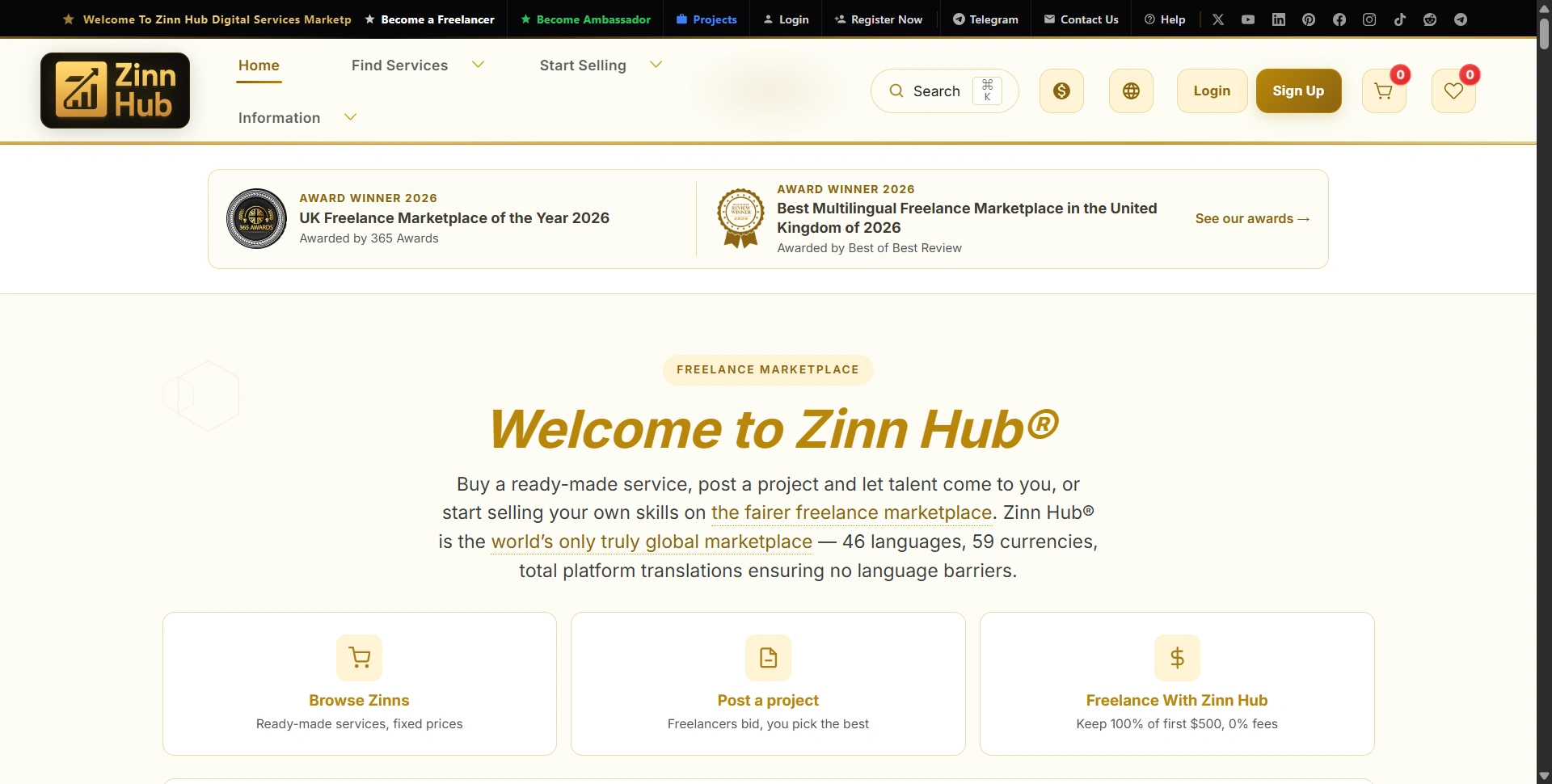
The homepage separates buying a service, posting a project and starting a freelance business.
My interest is in that combination. A founder might buy a landing-page audit today and need a custom implementation next week. A freelancer might sell a repeatable package while applying for larger assignments. Having both routes gives the relationship room to grow.
Why it belongs on your Upwork shortlist
The strongest reason to consider Zinn Hub as the best Upwork alternative for your situation is the cost of testing it.
Upwork's official Connects documentation prices purchased Connects at $0.15 each. Applications can require different amounts. The cost of pitching therefore depends on which jobs you pursue, alongside any free Connects you receive.
Zinn Hub's freelancer information describes 25 free project proposals per month on its Free tier. That creates a useful starting point for someone with a narrow skill and a limited budget.
I would spend that allowance carefully. Five relevant proposals with a clear example of previous work beat twenty-five generic introductions. Free applications remove a cash expense; they don't remove the need to understand the client's problem.
There is another distinction I care about: access to a marketplace and access to suitable demand are different things. Before moving your freelance business, look for recent projects in your niche and see whether buyers respond to your offer.
Zinn Hub vs Upwork vs Fiverr: the practical differences
Here is the comparison I would use before choosing where to test an offer. Fees were checked on October 9, 2026.
| Question | Zinn Hub | Upwork | Fiverr |
|---|---|---|---|
| What can you sell? | Packaged services and custom project work | Custom contracts and Project Catalog services | Packaged Gigs and custom offers |
| What does pitching cost? | 25 free proposals monthly on the Free tier | Purchased Connects cost $0.15 each; requirements vary | Gig discovery does not use Upwork's Connects system |
| What is the seller commission? | Free-tier introductory allowance, then sales-based tiers | 0–15% freelancer service fee | Sellers receive 80% of the purchase amount |
| What should you compare first? | Relevant projects and service scope | Contract terms and application costs | Package inclusions and order total |
Upwork publishes its current range on its freelancer pricing page. Fiverr confirms the 80% seller share in its earnings documentation. Zinn Hub's fees need their own explanation below.
This is why I wouldn't choose from a headline percentage alone. The practical winner is the place where a suitable client and a suitable freelancer can agree on work that makes financial sense.
Zinn Hub fees: read beyond the first $500
The introductory offer is attractive, but it isn't permanent zero-commission freelancing. Zinn Hub publishes these Free-tier sales bands:
| Published sales milestone | Platform commission |
|---|---|
| First $500 | 0% |
| $501–$2,500 | 20% |
| $2,501–$10,000 | 15% |
| $10,001–$15,000 | 13% |
| $15,001–$20,000 | 10% |
| Above $20,000 | 8% |
These are the rates shown on its become-a-freelancer page. Don't confuse the sales-tier names with paid membership plans.
The separate pricing page lists Pro at $25 monthly with an 8% commission and 100 monthly proposals, and Agency at $50 monthly with a 7% commission and unlimited proposals. It also states that processor charges, transfer costs and applicable VAT can affect payouts.
My approach would be simple: start free, learn whether your offer gets attention, then calculate membership value from actual sales. A subscription that lowers your percentage still adds a fixed expense. More proposal capacity is useful only if you have enough relevant projects to pursue.
For buyers, the platform advertises zero platform fees. Check the final checkout total and current terms for your purchase.
Is it also the best Fiverr alternative?
If you prefer buying a defined outcome, Zinn Hub deserves consideration as the best Fiverr alternative for your workflow. Its Zinns catalogue centres on fixed-price services, while custom projects cover work that doesn't fit an existing package.
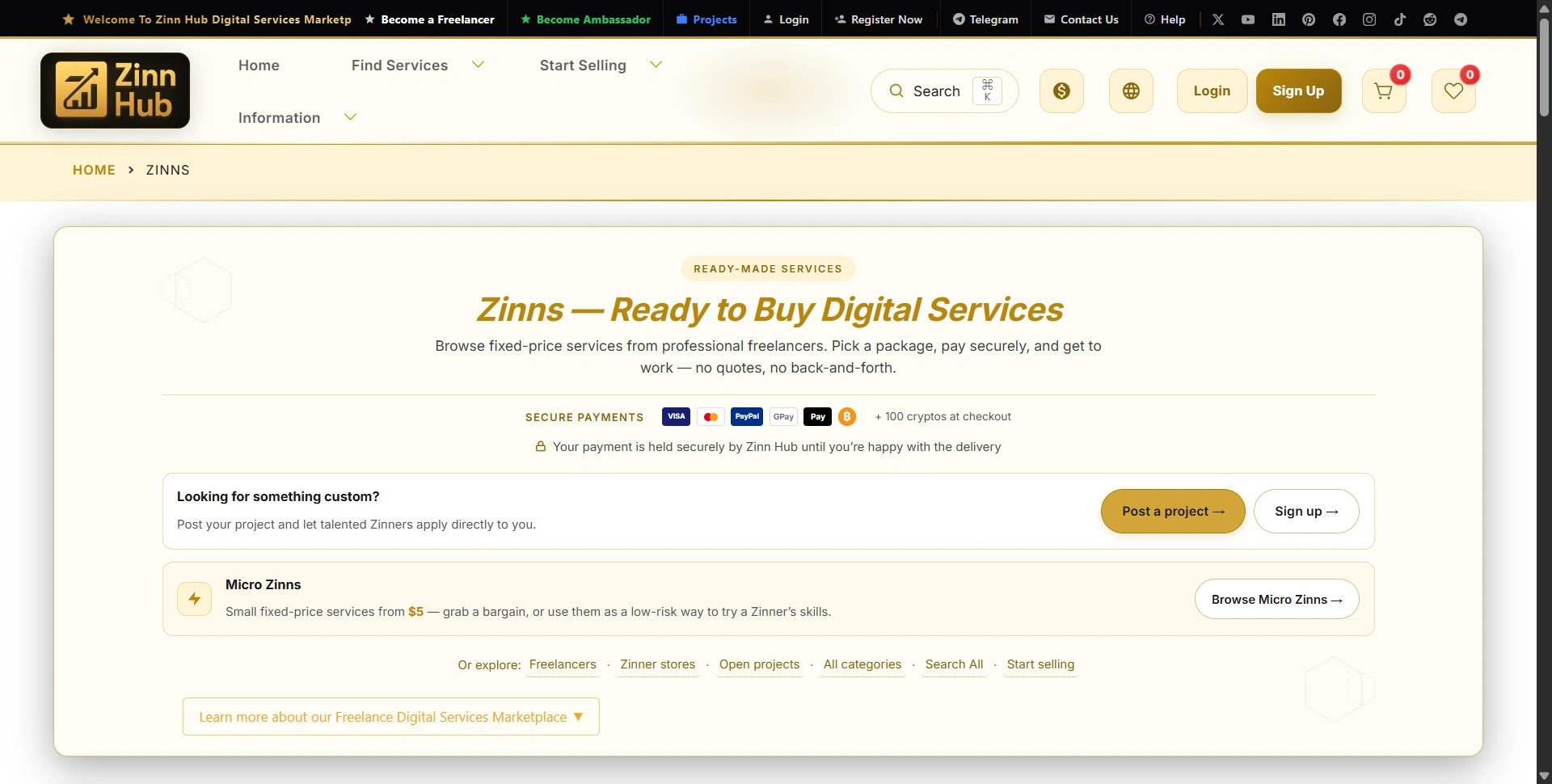
Ready-made services suit defined tasks; custom projects suit a brief that needs discussion.
The catalogue also promotes Micro Zinns starting at $5. I like the idea of a small paid trial before a bigger engagement, provided the task is useful on its own.
For example, commission one product graphic before a full campaign. Ask for a short technical assessment before committing to a rebuild. These are suggested ways to scope a trial, rather than promises about what every seller includes.
The important question is what you receive. Read the deliverables, revision allowance, turnaround time and exclusions. A cheap package becomes expensive when you discover that the piece you needed was an extra.
What founders can hire help with
Zinn Hub's marketplaces directory covers development, design, writing, marketing and AI work, including areas such as API integration, automation and landing pages.
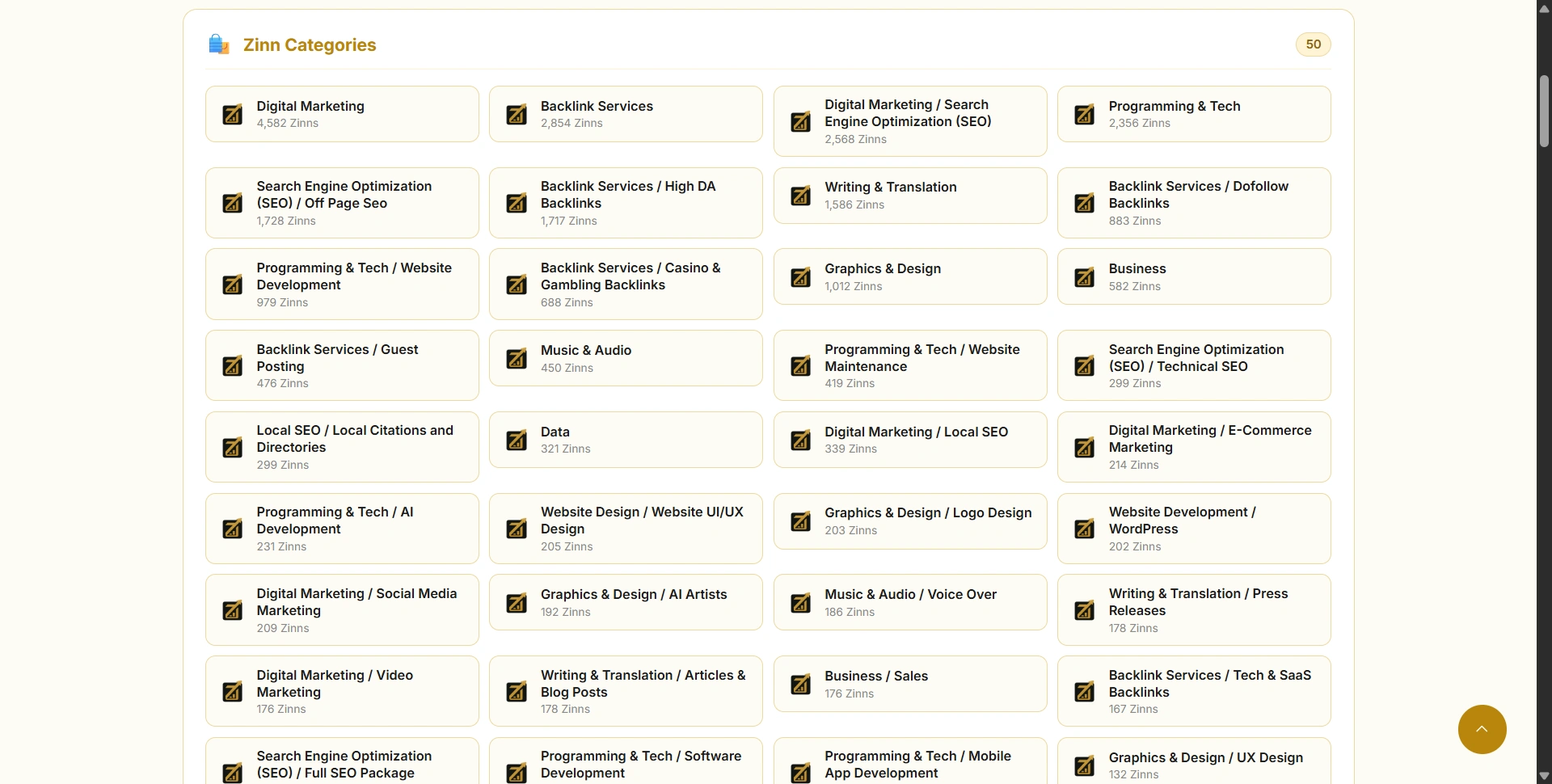
Category listings help narrow the search. Displayed listing counts aren't a measure of completed orders or quality.
I would begin with a bottleneck: the demo needs editing, onboarding emails need writing, or the landing page needs implementing. A specific output makes it easier to judge both the quote and the finished work.
Our SaaS launch checklist helps identify those tasks before you outsource. Pick something that frees you to spend more time with customers.
Use Zinner Skills when you need expertise rather than a broad service category. Skill tags help discovery, but a tag alone doesn't demonstrate competence. Ask for portfolio work that resembles your brief.
AI listing tools: useful help for freelancers
One feature worth exploring is the AI Zinn Creator. Zinn Hub's freelancer resources page describes it as a tool that turns a text prompt into a service-listing draft for the seller to approve.
That can help someone who knows their craft but struggles to package it. The seller still needs to check every promise.
My suggested prompt would name the customer, output, timeline and boundaries: a homepage copy review for an early-stage SaaS, with written recommendations and a revised hero section. That is easier to evaluate than an offer to transform a company's entire marketing.
Before publishing, replace vague claims with examples. State what the buyer must provide, what you will deliver and what happens if they need another revision. AI can speed up writing; your judgement makes the listing credible.
Buyer protection and testimonials: what I checked
Zinn Hub's buyer protection policy distinguishes platform-held payments from direct payments through a seller's connected Stripe or PayPal account. It says both have a dispute process, although the funding mechanics differ.
The policy gives buyers five calendar days to review delivery before automatic acceptance. It also describes approved refunds being credited to Zinn Wallet. Those details matter more to me than a general secure-payments badge.
Keep the agreed scope and communication on-platform, review delivery promptly and understand the refund destination before ordering. I haven't tested a dispute, so I can't assess how the process performs in practice.
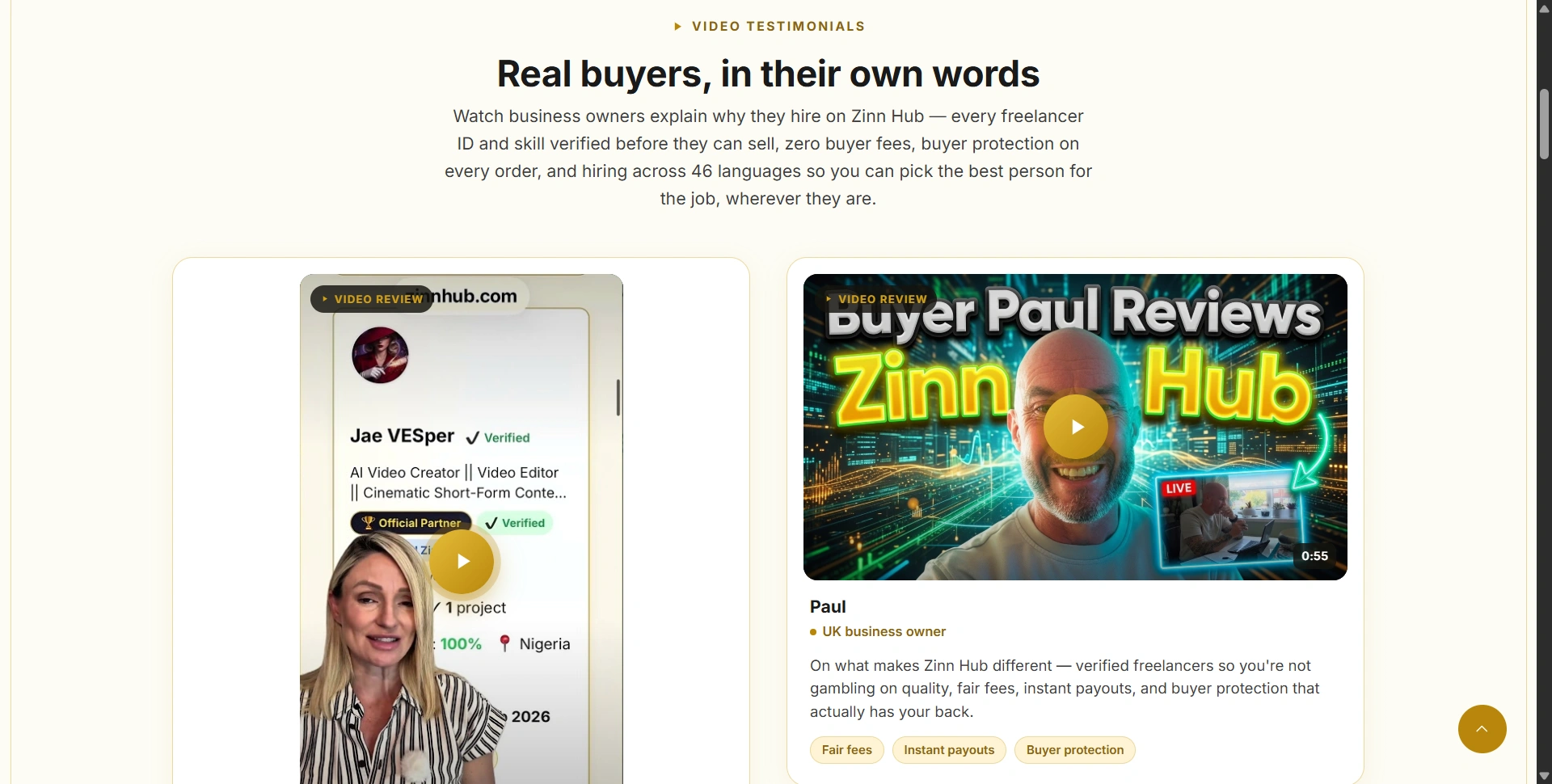
These testimonials are displayed by Zinn Hub. They are useful context, rather than an independent audit of delivery quality.
I would combine testimonials with seller-specific evidence: relevant samples, detailed reviews and clear answers to questions. Verification can help establish identity; choosing the right person still requires judgement.
How I would start as a buyer or freelancer
The supplied registration screenshot shows buyer, seller and ambassador roles. Choose the role that matches what you want to do first.
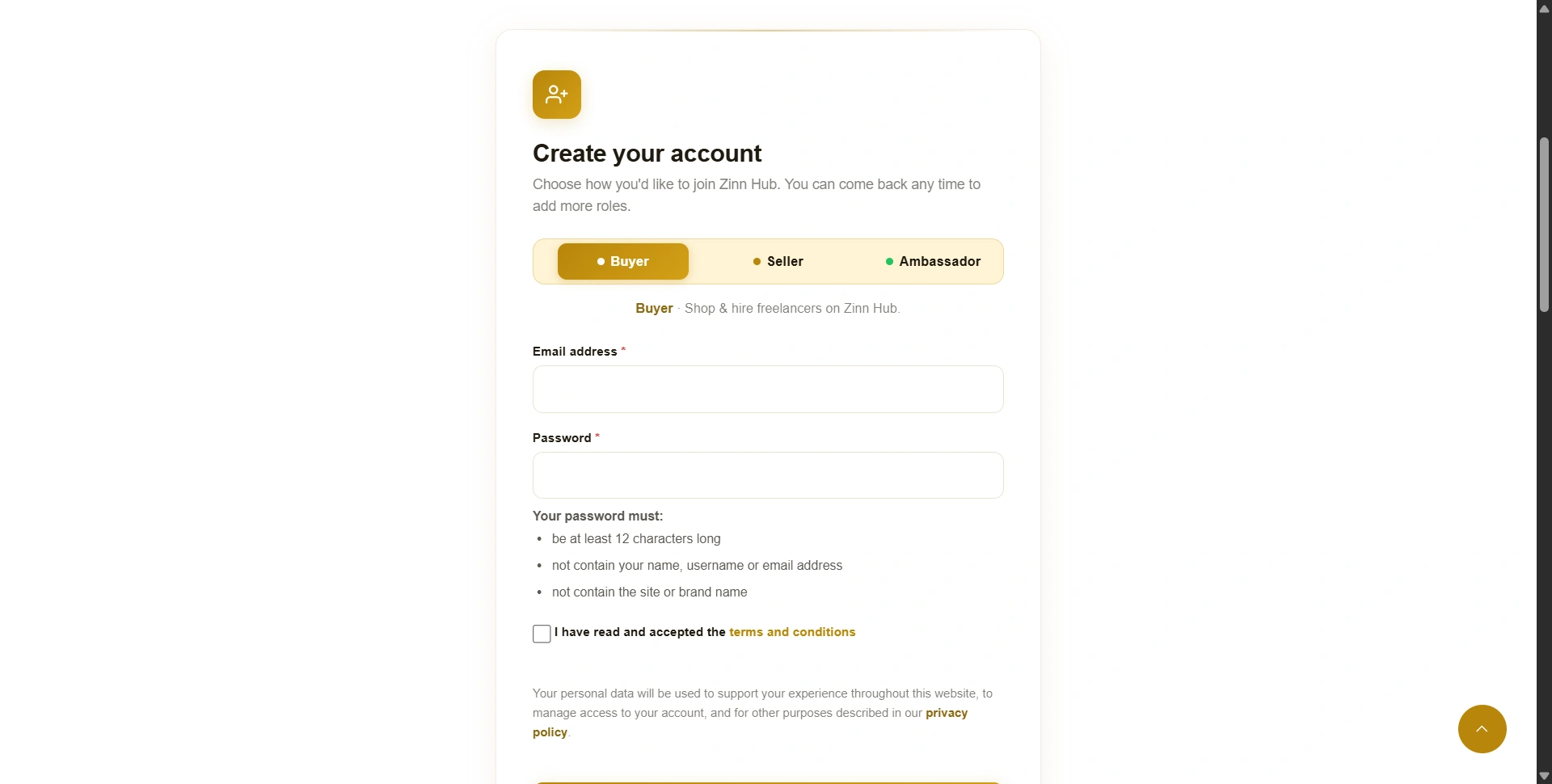
Registration separates hiring, selling services and participating as an ambassador.
For a buyer, my first brief would contain five things: the problem, deliverable, deadline, budget and acceptance criteria. Send it to a short list of relevant freelancers and compare how specifically they respond.
For a seller, I would publish one focused service, add relevant samples and apply to closely matched projects. Track replies and paid orders before expanding the catalogue.
Here is the experiment I would run over the first week. As a buyer, give two shortlisted freelancers the same brief and ask what they would need before starting. The more useful reply identifies missing information, explains the approach and sets a realistic boundary. That conversation often tells you more than a polished profile.
As a seller, record how many relevant projects you found, how many proposals you sent and how many conversations followed. Include the time spent preparing each application. A free proposal can still cost an hour, so judge the channel by qualified conversations per hour as well as money spent. Keep the offer stable during the experiment. Otherwise, you won't know whether a better response came from the marketplace, your new positioning or simply a different brief.
I also wouldn't rely on marketplace discovery alone. Our guide to launching a SaaS with no audience explains why useful conversations and consistent distribution matter. The same principle applies to a freelance offer: bring interested people to a page that clearly explains your work.
My verdict: a strong alternative worth testing
Zinn Hub earns a place on my shortlist because it brings packaged services and project proposals together with a free entry route. For freelancers watching application costs, and founders buying a defined piece of work, that is a practical reason to try it.
The limits of this review are clear: I haven't measured buyer demand, completed an order or tested payouts. Published features make it promising; your own small engagement will tell you whether it fits.
My recommendation is to start with one specific service or brief. Compare the response, finished output and total cost with your existing workflow. Expand when the evidence supports it.
Once your product is ready, FasLaunch can help with the next step: discovery through a product launch. Hiring and distribution solve different parts of the journey. Get something worth showing, then use our guide to choosing product launch platforms to decide where to introduce it.
Frequently asked questions
Is Zinn Hub the best Upwork alternative?
+
Zinn Hub is a strong candidate if you want free project proposals and fixed-price services in one marketplace. Its Free tier includes 25 proposals per month. The best choice still depends on relevant clients, freelancer quality and the total cost of your work.
Is Zinn Hub free for freelancers?
+
The Free tier has no monthly subscription and charges no platform commission on the first $500 in sales. Afterward, published commission tiers range from 20% down to 8%. Payment processing, transfer costs and applicable VAT can still affect earnings.
How does Zinn Hub compare with Fiverr?
+
Both offer packaged freelance services. Zinn Hub also offers custom project proposals and an introductory commission-free allowance. Fiverr's official earnings documentation says sellers receive 80% of an order's purchase amount. Compare the specific service and total costs before choosing.
Can founders hire developers and marketers on Zinn Hub?
+
Yes. Its marketplace pages include development, design, writing, marketing and AI services. Review relevant portfolio work, agree on deliverables and start with a small paid assignment before commissioning a larger project.
Does Zinn Hub offer buyer protection?
+
Zinn Hub publishes a buyer protection and dispute policy. Platform payments are held until completion; direct Stripe or PayPal payments use different funding mechanics. The policy describes a five-calendar-day delivery review window and refunds credited to Zinn Wallet. Read the current terms before ordering.