How to Launch a SaaS With No Audience: A 20-Day Plan
 Avinash10 min read
In short:You do not need 10,000 followers to launch a SaaS. You need a 20-day plan that turns other people's communities into your temporary launch audience: talk about the problem, join real conversations on Reddit and Facebook groups, reach a few well-matched micro-influencers, message potential customers directly, then launch on Product Hunt with people who already know you.
"I built a SaaS and have zero followers. How do I launch it?"
I hear a version of this question every week, and most guides answer it the same way: build a landing page, post on Product Hunt, send a few emails, hope. That advice assumes you already have something to send those emails and posts to. If your list is empty, it is not much of a plan.
Here is a plan built for zero. You will not have 10,000 followers in three weeks. But you can spend 20 days putting yourself and your product everywhere your future users already spend time, so that by launch day a few hundred of them already recognize your name.
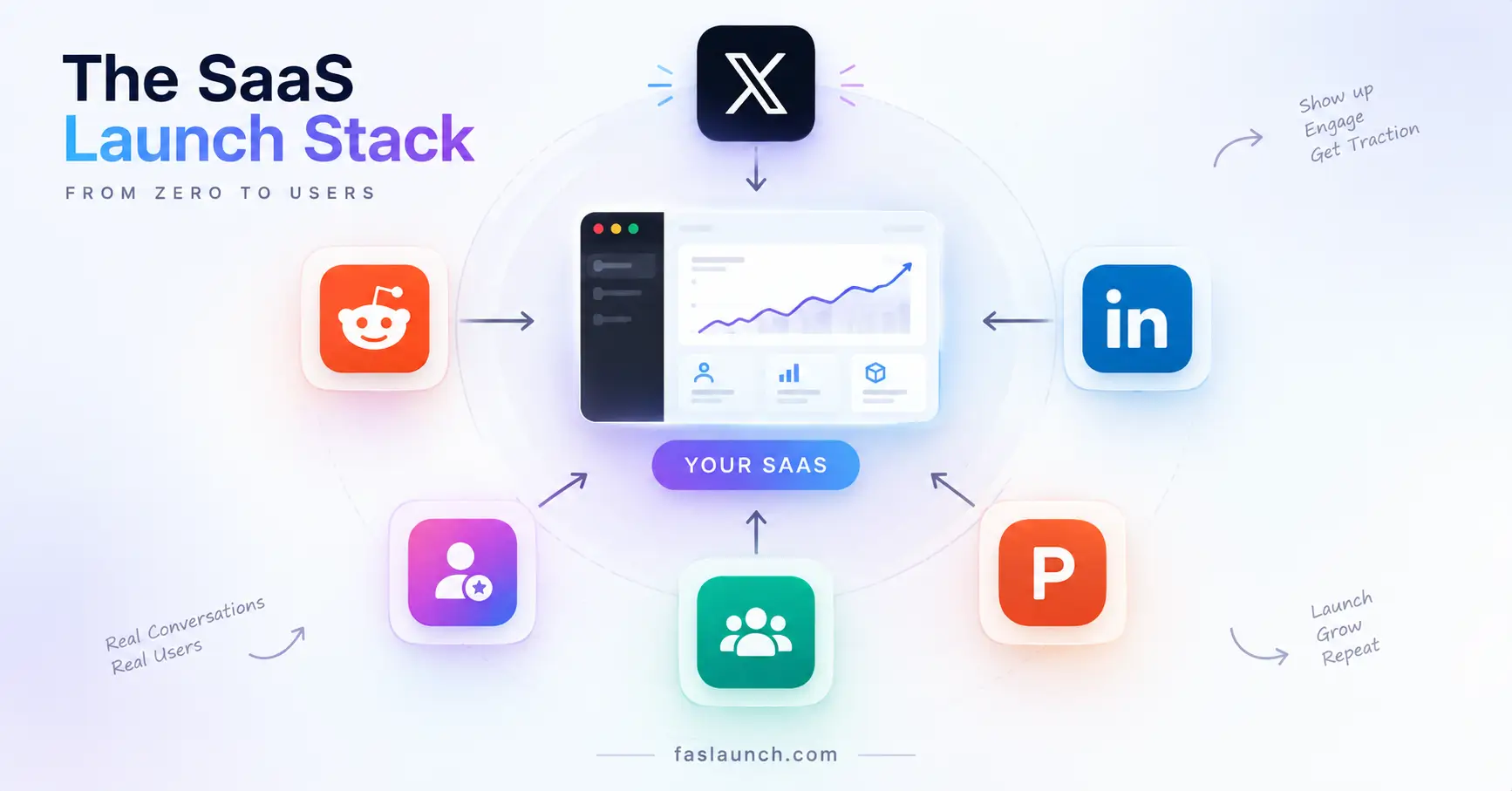
The full stack: build in public, join real conversations, then launch with people who already know you.
How do you launch a SaaS with no audience?
You do not manufacture an audience. You borrow attention from communities that already exist, for 20 days, by being useful in them. Then you turn that borrowed attention into a real, if small, group of people who show up on launch day.
The plan has four phases:
- Days 1-5: get visible. Start talking about the problem, in public.
- Days 6-10: join real conversations. Go where your users already are, and reach a few people directly.
- Days 11-15: build anticipation. Turn "I'm building something" into "it's almost here."
- Days 16-20: launch. Product Hunt, your list, and a day you actually manage.
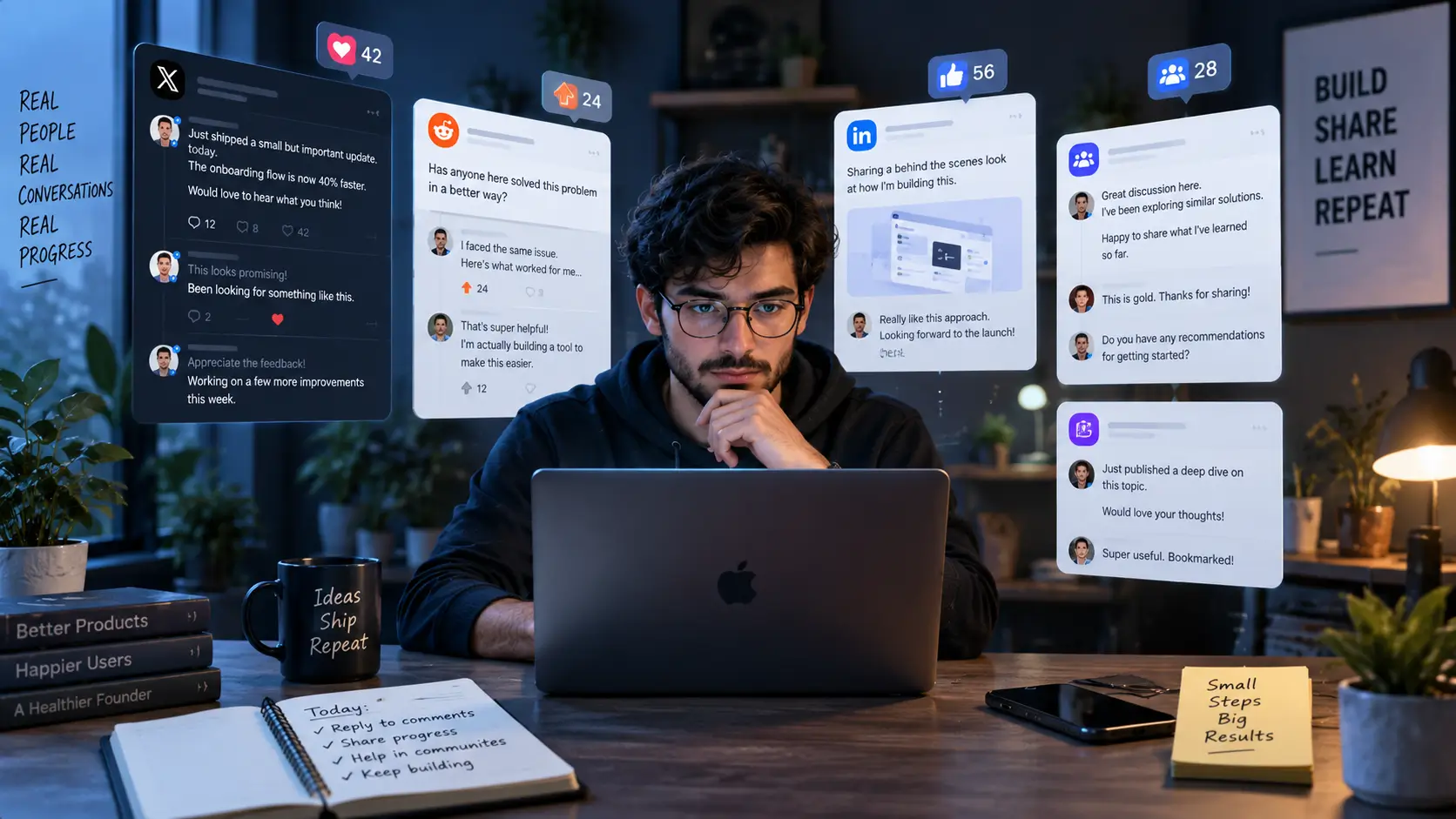
The 20-day framework this whole plan is built on.
Days 1-5: how do you get visible with zero followers?
You get visible by talking about the problem before you talk about the product.
Most founders open with: "Our SaaS is launching, sign up." Nobody without context cares. Instead, post the story in order:
"I've been doing X by hand for six months. It takes four hours a week."
"So I'm building something to automate it."
"Here's what I'm working on."
Then keep showing progress.
On X, post daily, and do not make every post a pitch. Mix in: the problem you are solving, screenshots of real progress, decisions you made and why, mistakes, small wins, and honest questions. Your goal is not one viral post. It is the same niche seeing you repeatedly, building something relevant to them.
On LinkedIn, rotate through the same ideas in a more professional voice: your founder story, the problem you noticed, what you shipped today, what you learned from ten user conversations. By day 20, you do not want people to think "who is this?" You want "I've seen this person building this."
Days 6-10: which communities should you join before you launch?
The rule here matters more than the list of platforms: don't use communities as distribution channels, use them as communities.
If you are building an AI developer tool, find communities where developers actually discuss that problem. An ecommerce SaaS belongs in ecommerce communities. An SEO tool belongs where SEOs hang out. That specificity is the whole point.
Potential communities include:
- r/SaaS
- r/microsaas
- r/SideProject
- a subreddit specific to your niche
Read each community's current rules before you post. They differ a lot: some subreddits allow limited self-promotion, others ban links entirely or require a specific weekly thread.
Your activity should look like:
Comment → help → discuss → answer → occasionally mention what you're building, when it's genuinely relevant.
Not:
Join → drop a link → leave.
That distinction is the whole strategy, not a detail inside it.
Facebook groups
Keep these too, but frame them the same careful way.
Find niche groups where your target customers already participate. Don't join 50 groups and post the same announcement. Instead:
- Answer questions
- Share useful lessons
- Ask research questions
- Discuss the problem
- Share what you're learning
- Participate consistently
Introduce the product only when it's genuinely relevant and the group's rules allow it.
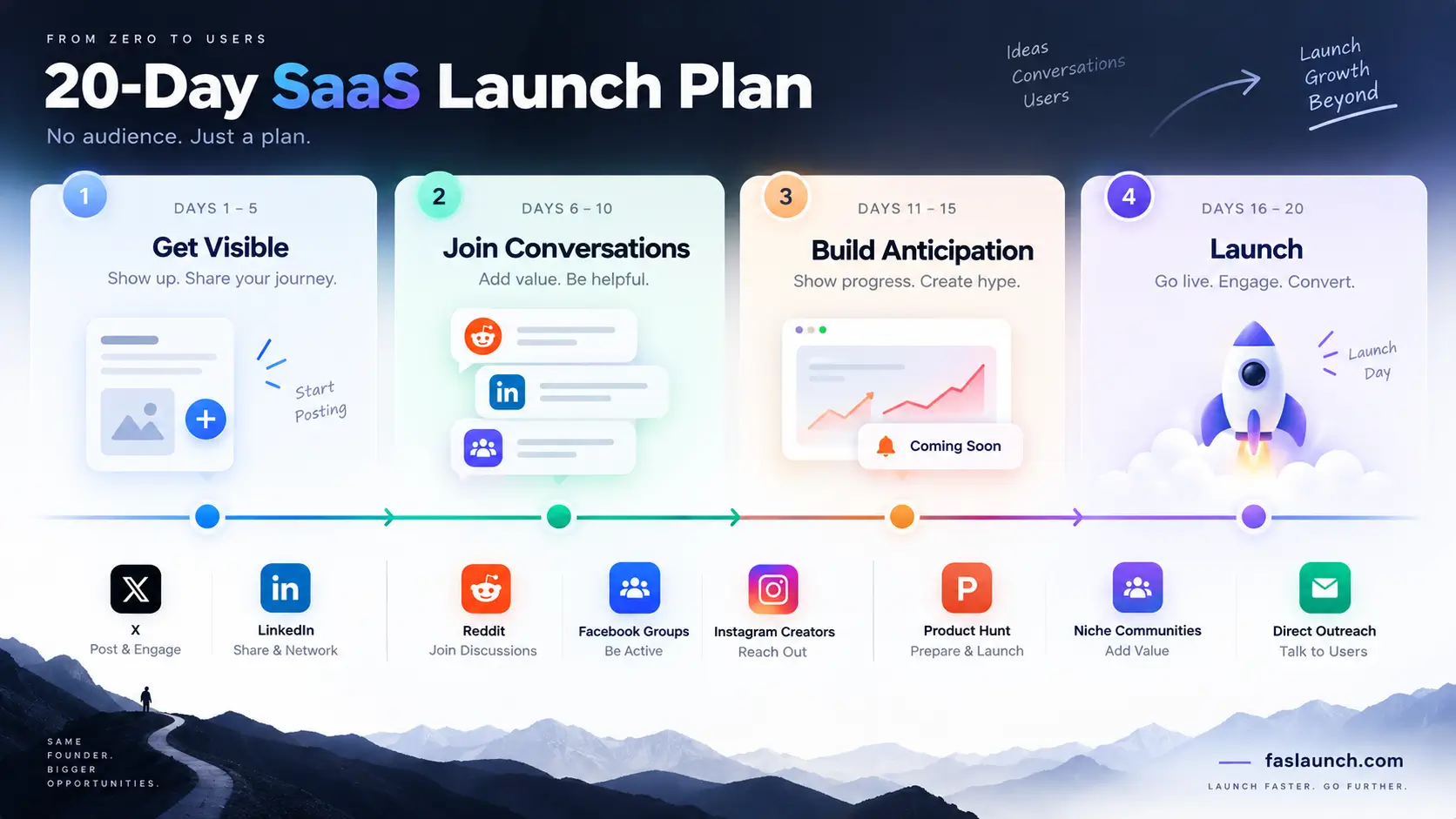
Real conversations, not link drops: reply, help, and only mention the product when it fits.
Should you contact influencers if you have no audience?
Yes, but skip the celebrities. Look for audience-product fit instead of follower count.
Find 10 to 30 creators whose audience closely matches your ideal customer: a SaaS founder's audience for a SaaS product, developers for a developer tool, marketers for a marketing tool. Do not send "please promote my SaaS." Send something closer to:
"I've been building X for [audience]. I think your audience would find the problem interesting. We're launching soon; I'd love your honest feedback."
Most will not answer. A few will, and a few of those become early users or collaborators. That is enough.
Should you message potential customers directly?
Yes, and this is the piece most no-audience plans skip entirely.
If you have zero followers, you can still have a list of 100 people who clearly fit your ideal customer. Find them, then message them personally. Not:
"Hey, check out my SaaS."
Instead:
"I noticed you do X. I built Y specifically to solve Z. We're launching next week, and I'm looking for 10 people in this space to try it."
Your first customers do not have to come from an audience. They can come from one-to-one conversations, one at a time, starting today.
Days 11-15: how do you build anticipation without an audience?
You turn "I am building something" into a story people have been quietly following, one honest update at a time.
Do not manufacture fake scarcity or fake traction. Instead, keep the narrative moving:
Day 11: "I've been building this for three months." Day 12: "Here's the biggest problem it solves." Day 13: "Here's what it looks like." Day 14: "We're launching next week." Day 15: "Here's what to expect on launch day."
This turns your launch from a random link appearing out of nowhere into episode 20 of something a few hundred people have already been half-watching.
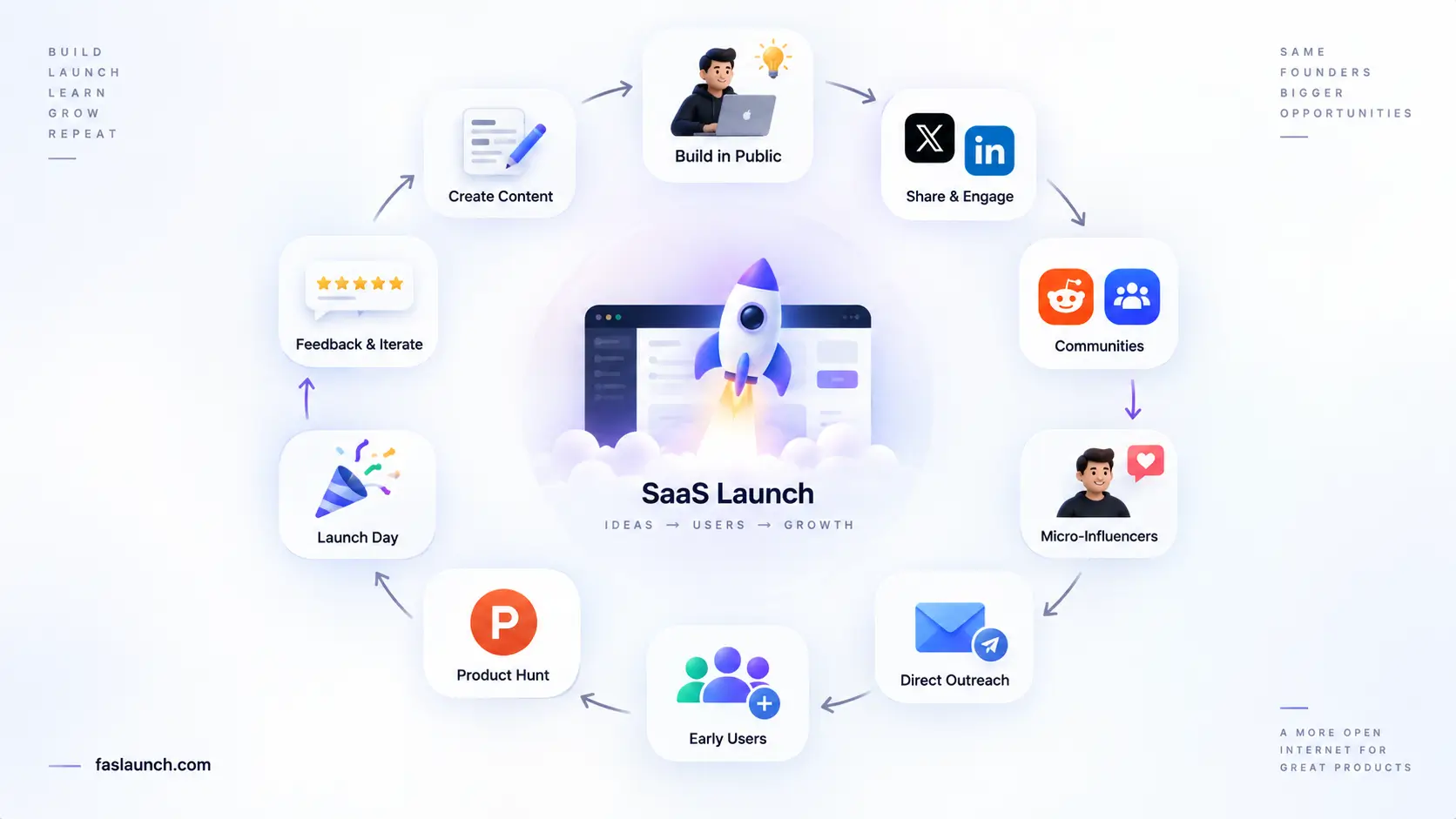
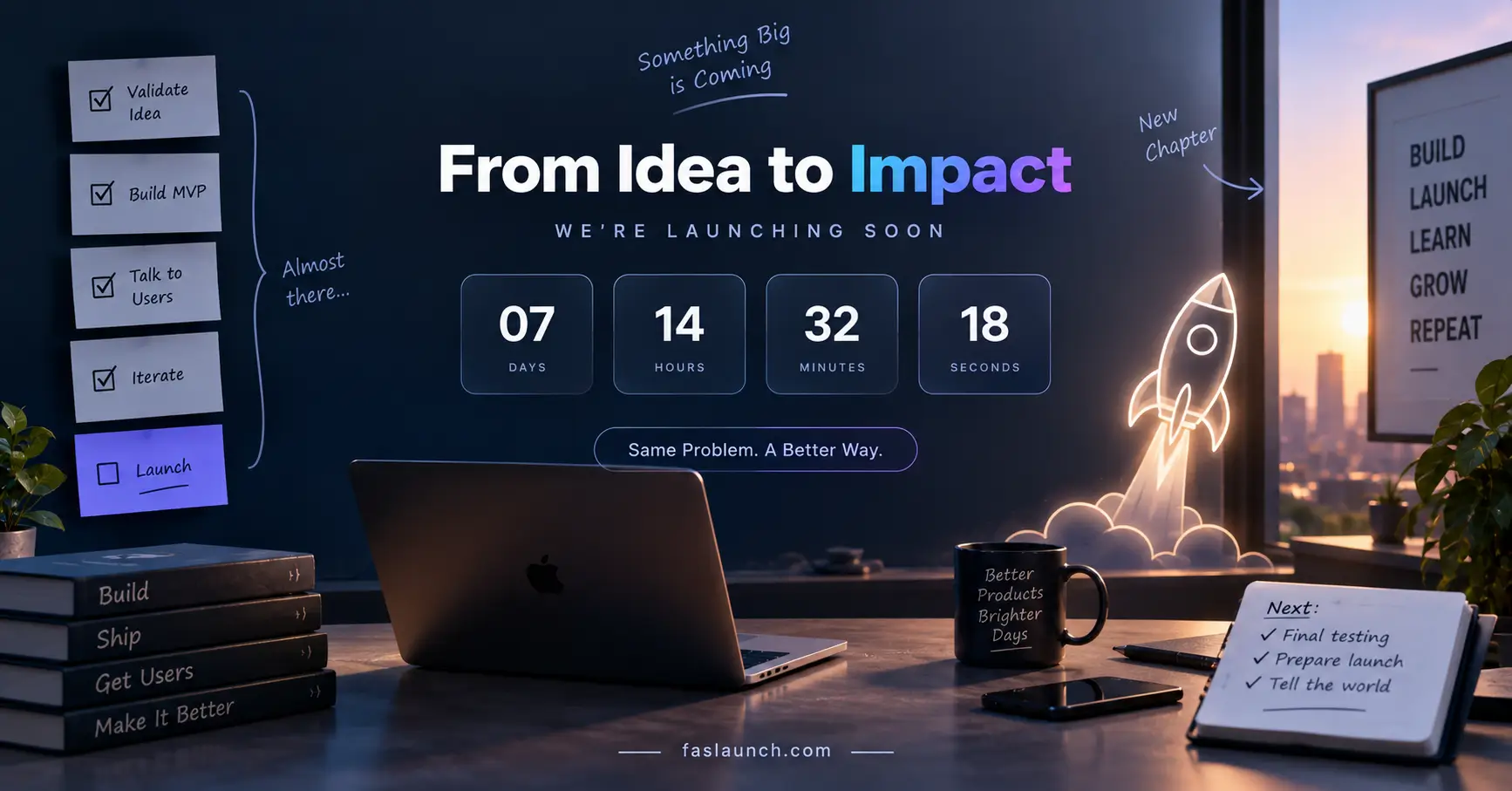
Turn silent progress into a countdown people can actually follow.
How do you build a launch list before you launch?
You do not need 10,000 emails. Even 50 to 100 genuinely interested people can be useful. Collect:
- X profile
- Community
- Early-user status
These people become your first launch-day audience: the ones who show up, reply, and share in the first hour.
Should you get feedback before launch day?
Yes. Give people the product early instead of waiting for launch day to hear anything. Ask:
- What's confusing?
- What would stop you from paying?
- What's missing?
- What would make you recommend this?
Then fix the biggest problems. Your launch gets stronger because it is not the first time anyone outside your head has seen the product.
Which other communities should you consider besides social media?
Depending on your SaaS, look beyond X, LinkedIn, Reddit and Facebook at:
- Indie Hackers
- Hacker News
- Discord communities
- Slack communities
- niche forums and industry-specific communities
- newsletters, podcasts and YouTube creators in your space
- niche publications
Do not publish everywhere just because a platform exists. Use one filter: where does my ideal customer already spend time? If the honest answer is "not there," skip it, no matter how popular the platform is.
Should you hire a hunter to get into Product Hunt's top 5?
No. Product Hunt's own current guidance says makers should hunt their own products, not rely on a third party, and it reports that the large majority of featured posts and top-ranked products of the day were self-hunted. It also explicitly prohibits asking for upvotes or running coordinated voting campaigns.
So drop "get us into the top 5" as the goal. Replace it with: qualified traffic, real feedback, early users, signups, and people who join your community. A ranking is a nice side effect of a good launch, not the definition of one.
Seven days before, prepare your Product Hunt assets: logo, tagline, description, gallery, a short demo, your maker profile, and a first comment that says what you built and why. Product Hunt itself recommends completing all of this before launch day, not during it.
Three days before, tell your warm audience you are launching on Product Hunt in three days. One day before, remind early users and the people in communities you have genuinely connected with, but as an invitation to give feedback, not a demand for votes.
What should launch day actually look like?
A coordinated day, not "wake up, post, wait."
In the morning, go live on Product Hunt. Immediately after, post on X, LinkedIn, your relevant community and your personal network. Through the day, respond to Product Hunt comments, X replies, LinkedIn comments, Reddit discussions, DMs and questions as they come in.
Do not just repeat "we're live." Share what is actually happening: "first ten users are in," "someone just found X," "here's what today's feedback taught us." The launch itself becomes content, and content is what keeps people engaged past the first hour.
Launch day is a job, not a moment: post, reply, and keep sharing what's actually happening.
Days 21-30: what do you do after launch day?
Do not stop. Most founders treat launch day as the finish line. It is actually the beginning of distribution.
Take everything that happened during launch and turn it into content:
- A customer question → a post
- Interesting feedback → a post
- A new feature → a post
- The launch result → a short case study
- A mistake → a founder story
- A kind comment → social proof
- Product Hunt comments → an FAQ
That is another two to four weeks of content, all of it drawn from things that actually happened, not things you had to invent.
What does the complete no-audience launch stack look like?
Put together, the whole plan is a loop, not a straight line:
Product → 20 days of building in public → X + LinkedIn → Reddit + niche communities → micro-influencers → direct outreach → waitlist / early users → Product Hunt → launch → customers + feedback → more content → more distribution.
Each stage feeds the next, and the last two stages feed back into the first: content from your launch becomes the thing that keeps building your audience for the next thing you ship.
Where does a directory fit into this plan?
As a base layer under everything above, not a replacement for it.
Product Hunt is one stop in your 20 days, not the whole plan. Once you are live, add your product to a directory that gives you a real page and a real link, so the work you did on X, Reddit and LinkedIn has somewhere permanent to point back to.
That is exactly what I built FasLaunch for. You add your product, and it goes live in minutes with its own page: who it is for, the problem it solves, the job it does, how it solves it, and what makes it different, the same five questions a stranger asks in the first ten seconds on your landing page. You can launch for free with our badge and a dofollow link, pay once and skip the badge, or launch free with a nofollow link if you are testing the waters. Products also land on a public leaderboard, ranked by Domain Rating, so early traction is visible, not just claimed.
If you also want to know which other directories are worth your time during this 20-day stretch, read are startup directories worth it in 2026, where I break down real data from 142 launch platforms, including which ones are free, dofollow, and actually indexed.
The 20-day plan, in one place
- Days 1-5: talk about the problem publicly on X and LinkedIn, daily, mostly not a pitch.
- Days 6-10: join Reddit and Facebook groups as a participant, not a poster with a link.
- Alongside that: contact 10-30 micro-influencers, and message potential customers directly.
- Days 11-15: turn progress into a countdown, build a small list, ship early access, get feedback.
- Throughout: stay open to Indie Hackers, Hacker News, Discord, Slack and niche newsletters wherever your ICP actually is.
- Days 16-20: prepare Product Hunt assets, warm your list, launch, and stay present all day.
- Days 21-30: turn everything that happened into your next month of content.
- Alongside launch: get a real, permanent page for your product, so all of this work has somewhere to send people back to.
You do not need an audience to launch a SaaS. You need 20 days of showing up in the right rooms, and a plan for what happens when the room finally looks at you. Launch your product on FasLaunch once you're ready, and let the leaderboard, not a follower count, start doing some of the talking for you.
Frequently asked questions
I built a SaaS and have zero followers. How do I launch it?
+
Spend 20 days building temporary attention instead of waiting for permanent followers. Talk about the problem you solve on X and LinkedIn, join real conversations in Reddit and Facebook groups, contact a handful of well-matched micro-influencers and potential customers directly, and build a small list of interested people before you launch on Product Hunt.
Can I really launch a SaaS with zero audience?
+
Yes. You are not manufacturing 10,000 followers in three weeks. You are showing up, consistently and usefully, in places where your future users already spend time, so that by launch day a few hundred people recognize your name.
Should I hire someone to get my Product Hunt launch into the top 5?
+
No. Product Hunt's own guidance says most featured and top-ranked products are hunted by their own makers, not a third party, and it prohibits asking for upvotes or running coordinated voting. Aim for real feedback and real users, not a leaderboard position.
What should I do after launch day?
+
Keep going. Turn what happened during launch, questions, feedback, small wins, into two to four more weeks of content. Most founders treat launch day as the finish line. It is closer to the starting gun.